
 MY ACCOUNT
 STORAGE LEVELS
 WATER DATA
 ANNOUNCED ALLOCATIONS
 NEWS
NEWS
Dawson Valley
Scheme

Announced Allocations

(Upper Dawson)
(Upper Dawson)
(Upper Dawson)
(Lower Dawson)
(Lower Dawson)
Storages

Water Pricing


Scheme information
About
The Dawson Valley Scheme consists of a network of channels and weirs that extend along the Dawson River from upstream Theodore to downstream Boolburra. It supports irrigation customers as well as urban and industrial users.
From 1 October 2018, Theodore Water took over ownership and management of the scheme. Sunwater continues to manage the bulk assets, including the Dawson River Weirs.
Please refer to the Theodore Water website for further information.
How the scheme works
- The scheme relies on six weirs – Theodore, Orange Creek, Moura, Glebe, Neville Hewitt and Gyranda Weirs – and contains the Theodore and Gibber Gunyah channel systems
- The channel supply network is 56km in length with a 54km open earth drainage system also in place
- Theodore Pumping Station supplies water to the Theodore channel system, while a separate pumping station supplies water to the Gibber Gunyah channel system.
Glebe Beneficial Use Scheme (GBUS)
- The GBUS utilises coal seam gas water treated at the Northern Water Treatment Plant
- Treated water into the Glebe Weir is mainly for use by irrigators
- The release of treated water is regulated under the Department of Environment and Heritage Protection’s End of Waste Approval ENEW07542518
- Sunwater conducts water quality monitoring and publishes data reports for each scheme.
Water uses
- Irrigation water for agriculture including cotton, fodder, cereal and horticultural crops
- Urban water supply for Theodore, Moura, Baralaba and Duaringa
- Industrial water supply primarily for mining.
Scheme Management
Sunwater must comply with the conditions set out in the Dawson Valley Water Supply Scheme Resource Operations Licence (ROL), issued to Sunwater in May 2006 by the Department of Regional Development, Manufacturing and Water (DRDMW). The ROL outlines the infrastructure details, environmental release rules and all Sunwater’s monitoring and reporting obligations. The ROL also requires Sunwater to operate in accordance with an operations manual that is approved by DRDMW. The operations manual outlines rules for the operation of infrastructure associated with the Dawson Valley scheme as well as water sharing rules and seasonal water assignment (temporary trade) rules.
The Dawson Valley Water Supply Scheme ROL Operations Manual was issued in September 2022.
Sunwater focuses our resources towards timely and cost-efficient delivery of water to customers in the Dawson Valley scheme. We collaborate with our customers to ensure we understand their needs, adapt quickly to changes in the environment and make the most of the available water supply. To best manage water delivery, arrangements for taking of water within the Scheme have been developed in consultation with its Irrigator Advisory Committee.
Taking water from the scheme
The water ordering system assists Sunwater in delivering water to its customers in an efficient and timely way, enabling them to plan and manage their water use.
Before taking any water, customers should place a water order so that Sunwater can release sufficient water and minimise losses.
Customers who take water without ordering may reduce Sunwater’s ability to supply customers who have ordered according to the above requirements.
To place an order
Customers can place their orders via:
- Sunwater Online
- Sunwater Customer Support on 13 15 89
Further information about ordering water is detailed in Dawson Valley’s Rules and Targets.
Delivery timing
Orders are processed on a daily basis at 6:30am. Orders received after this time cannot be processed until the following day. Please make allowance for these times when placing your order.
The travel time, the number of hours/days it takes from the morning after the order is placed to get water from the dam or weirs to your pump, is:
| Dawson Valley Scheme Area | Travel time after order is placed |
| Above Theodore Weir | 4 Days |
| Moura Weir to Atkinson | 4 Days |
| Theodore Weir to Paranui Crossing | 6 Days |
| Neville Hewitt Weir to Duaringa | 15 days |
| Cancellation of original River order | 1 Day |
Stopping or restricting supply
Sunwater may suspend or restrict supply in a number of circumstances, including:
- during maintenance of Sunwater’s assets
- during a peak demand period, when rosters or rations may apply
- when the demand for water is so small it is impractical to supply it
- when there is a need to make special releases to maximise efficiency at times of limited supply
- during rain shutdown
- infrastructure limitations which make delivery impractical
- if supply could cause Sunwater to break the law
- when operating under special notices or regulations issued by the Department of Natural Resources and Mines {e.g. Water Amendment Regulation (No.3) 2006}.
Weather events and emergency shutdowns
Sunwater asks that customers notify their duty Water Officer, as soon as possible, of any rain event or other circumstances that substantially lessens their water requirements. When wide-spread general rain exceeds 40 mm in a day over the Dawson Valley Water Supply Scheme, the duty Water Officer may shut the system down.
Customers are also asked to cancel orders if they no longer require ordered water.
For more information contact
If you experience an equipment or power failure emergency, please give immediate notice to Sunwater by calling Sunwater Customer Support on 13 15 89 (24 hours a day, 7 days a week).
Dawson Valley’s Customer Advisory Committee
Sunwater is committed to open and transparent communication and collaboration with our customers. The role of the Customer Advisory Committee (CACs) is to provide customers and stakeholders with a diverse forum for collaboration and consultation with Sunwater on a range of strategic matters relating to Sunwater’s innovation, management and maintenance of assets to ensure the reliable and efficient delivery of service.
The primary purpose of the CACs is to:
- Engage with customers to identify current and future water needs.
- Provide a transparent view of Sunwater’s operating environment and assets, and how these influence our services to customers.
- Build an understanding of our customer’s businesses to ensure future plans are considered in Sunwater’s strategic and operations planning.
Stay up to date with the Dawson Valley Customer Advisory Committee.
Announced Allocations
Water Year: 2023/2024
Upper Dawson Subscheme
High priority: 100%
Medium priority: 67%
Medium A priority: 87%
Announced Allocations effective 1 April 2024 and will be applicable until revised and communicated by Sunwater.
2022/2023 to 2023/2024 Carryover Parameters – Cap 2,422 ML with 100% pro rata and 10% loss factor.For more information about the scheme’s carryover conditions click here.
Lower Dawson Subscheme
High priority: 100%
Medium priority: 92%
Announced Allocations effective 31 January 2024 and will be applicable until revised and communicated by Sunwater.
2022/2023 to 2023/2024 Carryover Parameters – Cap 836 ML with 74.317% pro rata and 10% loss factor.For more information about the scheme’s carryover conditions click here.
Customers are advised to obtain information about their remaining water allocation balance by accessing SunwaterOnline.
For more information or enquiries, phone 13 15 89 or email customersupport@sunwater.com.au.
History of Announced Allocations

Operational reports
Sunwater releases periodic operational reports detailing Announced Allocation levels and individual storages’ breakdowns within each scheme, the latest of which can be found below.
Upper Dawson
Lower Dawson
Service and Performance Plans
Sunwater prepares an annual Service and Performance Plan (S&PP) for each irrigation service contract area. S&PPs replace the former annual Network Service Plans and annual Performance Reports.
We have updated the naming convention for S&PPs to improve clarity and alignment with plan content. The new convention references the year in which the S&PP is published (or should have been published). Publication should occur within six months of the end of a financial year.
For further information about this service, please visit the Service and Performance Plan page.
Scheme news
Scheme history
Dawson Valley Water Supply Scheme
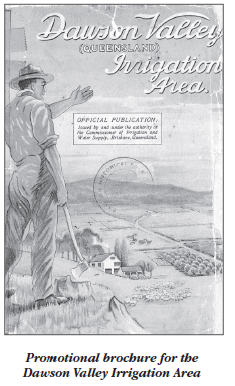
Queensland’s first major irrigation project was instigated by Premier E.G. Theodore in 1923 who was keen to open the Dawson Valley to agriculture.
The first weir was built on the Dawson River and then land was sub-divided into 5 ha parcels, each with a small house, to entice farmers from New South Wales and Victoria to head north. The town of Theodore grew to service these farms.
Today the scheme relies on six weirs — Theodore, Orange Creek, Moura, Glebe, Neville Hewitt and Gyranda — and contains the Theodore and Gibber Gunyah channel systems.
It supplies farm irrigation, including cotton, fodder and cereals, urban water supply for Theodore, Moura, Baralaba and Duaringa, and industrial water primarily for mining.